Get Green
Get Green
Applying principles from behavioral psychology and tackling usability issues to enhance long-term engagement for a sustainability app

TIMELINE
JAN 2022 - JUN 2022
JAN 2022 - JUN 2022
TEAM
3 Design Students
3 Design Students
ROLE
I assisted with all design deliverables but took ownership over the survey, wireflows, and designed the homepage medium-fidelity screen.
I assisted with all design deliverables but took ownership over the survey, wireflows and designed the homepage medium-fidelity screen.
BACKGROUND
Get Green is a mobile app that offers actionable sustainability tasks that people can easily integrate into their daily routines.
These tasks are as simple as choosing to eat a plant-based meal one day a week or replacing your gym workout with an outdoor workout. As you complete these tasks, you are rewarded leaves that can then be donated to various carbon removal projects. Our team partnered with Get Green to re-design their mobile app experience with a focus on improving the beta version of their geo-location features.
Get Green is a mobile app that offers actionable sustainability tasks that people can easily integrate into their daily routines.
These tasks are as simple as choosing to eat a plant-based meal one day a week or replacing your gym workout with an outdoor workout. As you complete these tasks, you are rewarded leaves that can then be donated to various carbon removal projects. Our team partnered with Get Green to re-design their mobile app experience with a focus on improving the beta version of their geo-location features.
PROBLEM
The challenge
The challenge
The GetGreen app faced issues retaining users long-term. This was because it lacked a clear task structure, in-app guidance, personalization, and features that encourage habit formation.
The GetGreen app faced issues retaining users long-term. This was because it lacked a clear task structure, in-app guidance, personalization, and features that encourage habit formation.
SOLUTION 01
Experience tailored to your sustainable goals.
Experience tailored to your sustainable goals.
We wanted to make things more intentional—allowing people to focus on actions that truly matter to them and have them feel like their actions lead to an end goal. Therefore, we centered the entire experience around completing goals rather than individual actions. In the onboarding process, users can select sustainability goals that interest them and choose corresponding actions to that goal.
We wanted to make things more intentional—allowing people to focus on actions that truly matter to them and have them feel like their actions lead to an end goal. Therefore, we centered the entire experience around completing goals rather than individual actions. In the onboarding process, users can select sustainability goals that interest them and choose corresponding actions to that goal.
SOLUTION 02
A personalized, action plan for effortless action discovery.
A personalized, action plan for effortless action discovery.
An individualized action plan is generated for users after their onboarding process. They receive 1-3 personalized daily action suggestions and can re-arrange them based on preference. Furthermore, users have the option to transform specific actions into habits by specifying the frequency of their repetition. To boost motivation, progress bars are prominently displayed at the top, motivating users to accomplish their goals, while streaks are implemented to encourage consistency.
An individualized action plan is generated for users after their onboarding process. They receive 1-3 personalized daily action suggestions and can re-arrange them based on preference. Furthermore, users have the option to transform specific actions into habits by specifying the frequency of their repetition. To boost motivation, progress bars are prominently displayed at the top, motivating users to accomplish their goals, while streaks are implemented to encourage consistency.
SOLUTION 03
Increased customizability of experience.
Increased customizability of experience.
Users have the flexibility to tailor their notification preferences, choosing the type and timing that best suits their needs. They can also customize streaks, frequency of repeatable actions, and more, ensuring that their sustainable journey seamlessly aligns with their unique lifestyle.
Users have the flexibility to tailor their notification preferences, choosing the type and timing that best suits their needs. They can also customize streaks, frequency of repeatable actions, and more, ensuring that their sustainable journey seamlessly aligns with their unique lifestyle.
How was success measured?
How was success measured?
Our product did not go to market so we don’t have any KPIs to report. However, here are some of the answers from our usability test.
Our product did not go to market so we don’t have any KPIs to report. However, here are some of the answers from our usability test.
“I would recommend this for people like me who are organized and sustainable.”
Anonymous Participant
“Very likely. Having an app that tells me to do something and setting intention works for me. I like how it tells me what to do.”
Anonymous Participant
“It’’s just easy to use, not something I personally have seen on the marketplace. It felt intuitive, I didn’t struggle at all.”
Anonymous Participant
“The functions that I did get to try out were easy to use, pretty engaging and interesting stuff.”
Anonymous Participant
OUR INITIAL DESIGN QUESTION
How might we engage users in building sustainable habits, ensuring long-term engagement through geo-location based technologies?
How might we engage users in building sustainable habits, ensuring long-term engagement through geo-location based technologies?
BACKGROUND
What are geo-location based technologies?
What are geo-location based technologies?
Get Green wants to send users notifications to complete actions based on their location. For instance, if users are at a grocery store they might receive an alert reminding them to participate in Meatless Monday. This feature hopes to bring another avenue of engagement. They had a beta version that they wanted us to improve on.
Get Green wants to send users notifications to complete actions based on their location. For instance, if users are at a grocery store they might receive an alert reminding them to participate in Meatless Monday. This feature hopes to bring another avenue of engagement. They had a beta version that they wanted us to improve on.
RESEARCH
Understanding how the app fits into people’s daily routine
Understanding how the app fits into people’s daily routine
We wanted to explore how users interact with notifications and the app when considering adding geo-location features. Our goal was to understand what motivates users to complete actions and why they might ignore them.
We wanted to explore how users interact with notifications and the app when considering adding geo-location features. Our goal was to understand what motivates users to complete actions and why they might ignore them.
12 users
12 users
recruited from word of mouth, online university forums, and campus sustainability clubs
recruited from word of mouth, online university forums, and campus sustainability clubs
2 weeks
2 week
long duration with daily short surveys and weekly long diary reflections
long duration with daily short surveys and weekly long diary reflections

FINDINGS
Key insights
Key insights
87% of users completed <2 actions per day
94% of users ranked below a 3 when asked to rate their interest in the app on a scale of 1–5 (1 being the least, 5 being the most)
55 responses said that the notifications did not change their actions
87% of users completed <2 actions per day
94% of users ranked below a 3 when asked to rate their interest in the app on a scale of 1 -5 (1 being the least, 5 being the most)
55 responses said that the notifications did not change their actions
RESEARCH
Co-design sessions to understand the “why” behind the actions & collaborate on solutions
Co-design sessions to understand the “why” behind the actions & collaborate on solutions
Through collaborative activities and discussions, we unpacked the participants experiences with the app and got insight into how they believe the experience could be redesigned.
Through collaborative activities and discussions, we unpacked the participants experiences with the app and got insight into how they believe the experience could be redesigned.
6 users
6 users
recruited from the diary study sessions
recruited from the diary study sessions
3 activities
3 activities
conducted during the session revolving around current sustainable habits, habit formation with phones, and experiences using the app
conducted during the session revolving around current sustainable habits, habit formation with phones, and experiences using the app

FINDINGS
Key insights
Key insights
2 users mentioned they wanted a better way to track progress for long actions
4 users mentioned that the actions they received were not relevant to them
2 users mentioned that they wanted more affordances for repeatable actions
2 users mentioned they wanted a better way to track progress for long actions
4 users mentioned that the actions they received were not relevant to them
2 users mentioned that they wanted more affordances for repeatable actions
RESEARCH
Capturing attitudes on sustainability, habit formation & location tracking
Capturing attitudes on sustainability, habit formation & location tracking
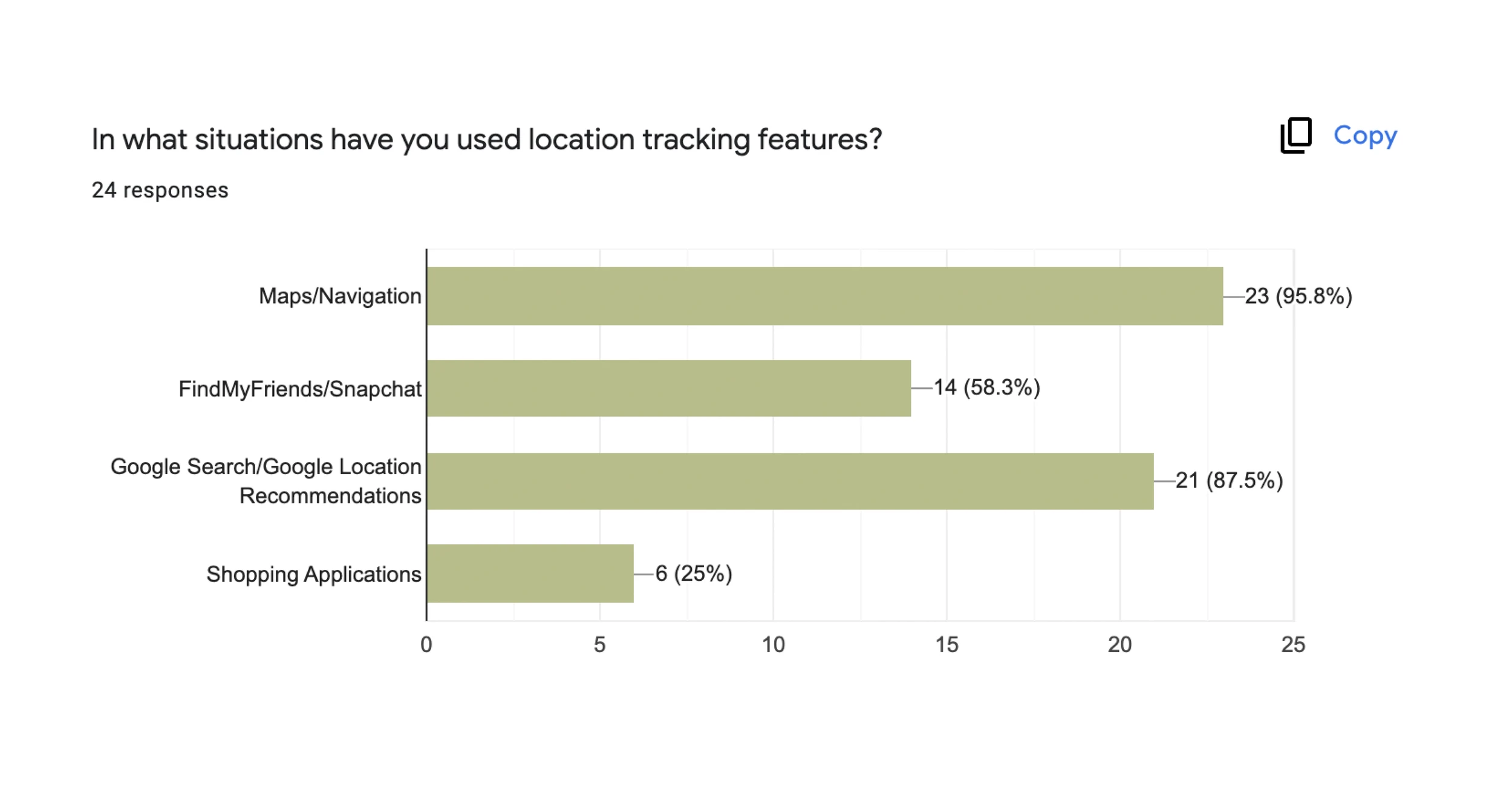
The purpose of the survey was to understand different ways users form habits, what their current sustainability habits are and their thoughts on location-tracking.
The purpose of the survey was to understand different ways users form habits, what their current sustainability habits are and their thoughts on location-tracking.
6 users
6 users
recruited from word of mouth, social media, online forums, and campus sustainability clubs
recruited from word of mouth, social media, online forums, and campus sustainability clubs
16 questions
16 questions
asked in the survey - a blend of qualitative and quantitative insights
asked in the survey - a blend of qualitative and quantitative insights
FINDINGS
Key insights
Key insights
37.5% of users scored a 3 on a Likert scale asking how comfortable they were with location tracking
Phones help users form habits by giving consistent notifications, helping users maintain a ‘streak’ , and scheduling tasks around their schedule
The top 3 sustainable actions people want to start doing are using less plastic, secondhand shopping, and lowering carbon emissions
37.5% of users scored a 3 on a Likert scale asking how comfortable they were with location tracking
Phones help users form habits by giving consistent notifications, helping users maintain a ‘streak’ , and scheduling tasks around their schedule
The top 3 sustainable actions people want to start doing are using less plastic, secondhand shopping, and lowering carbon emissions
PAIN POINTS
Challenges in saving, personalization, and organization of action suggestions
Challenges in repeatable actions, task breakdown, and notification customization
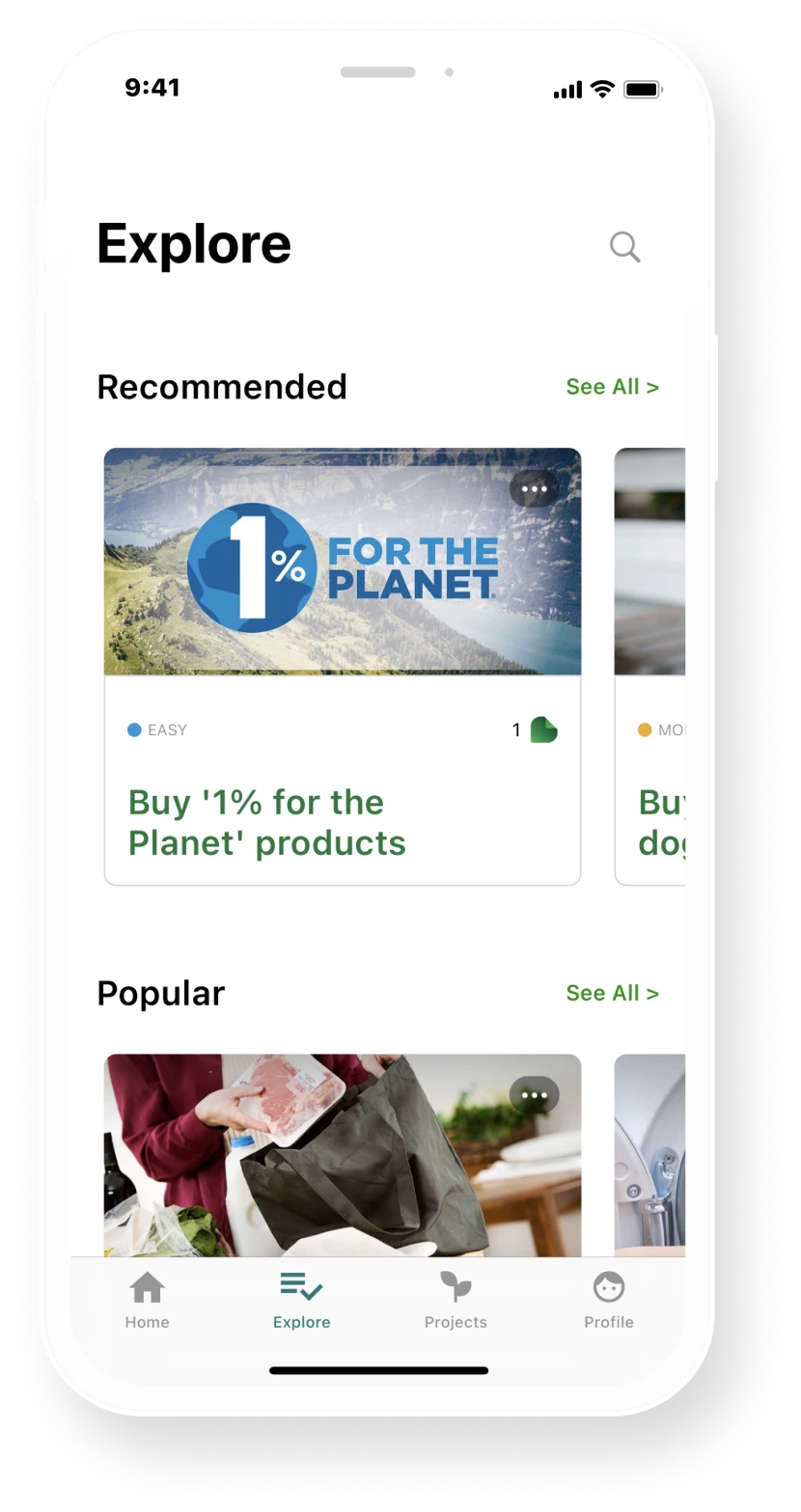
Actions that users want to complete cannot be saved anywhere.
Users are unable to save actions they want to complete, forcing them to endlessly scroll to find the action once they have completed it.
Action suggestions are not personalized to the user.
Users repeatedly receive action suggestions that hold no interest to them or are unrelated and unattainable for their specific circumstances.
No filtering or organization of the action suggestions.
Users get overwhelmed from the endless amount of options and want a way to filter out/hide action suggestions.
PAIN POINTS
Challenges in repeatable actions, task breakdown, and notification customization
Challenges in repeatable actions, task breakdown, and notification customization
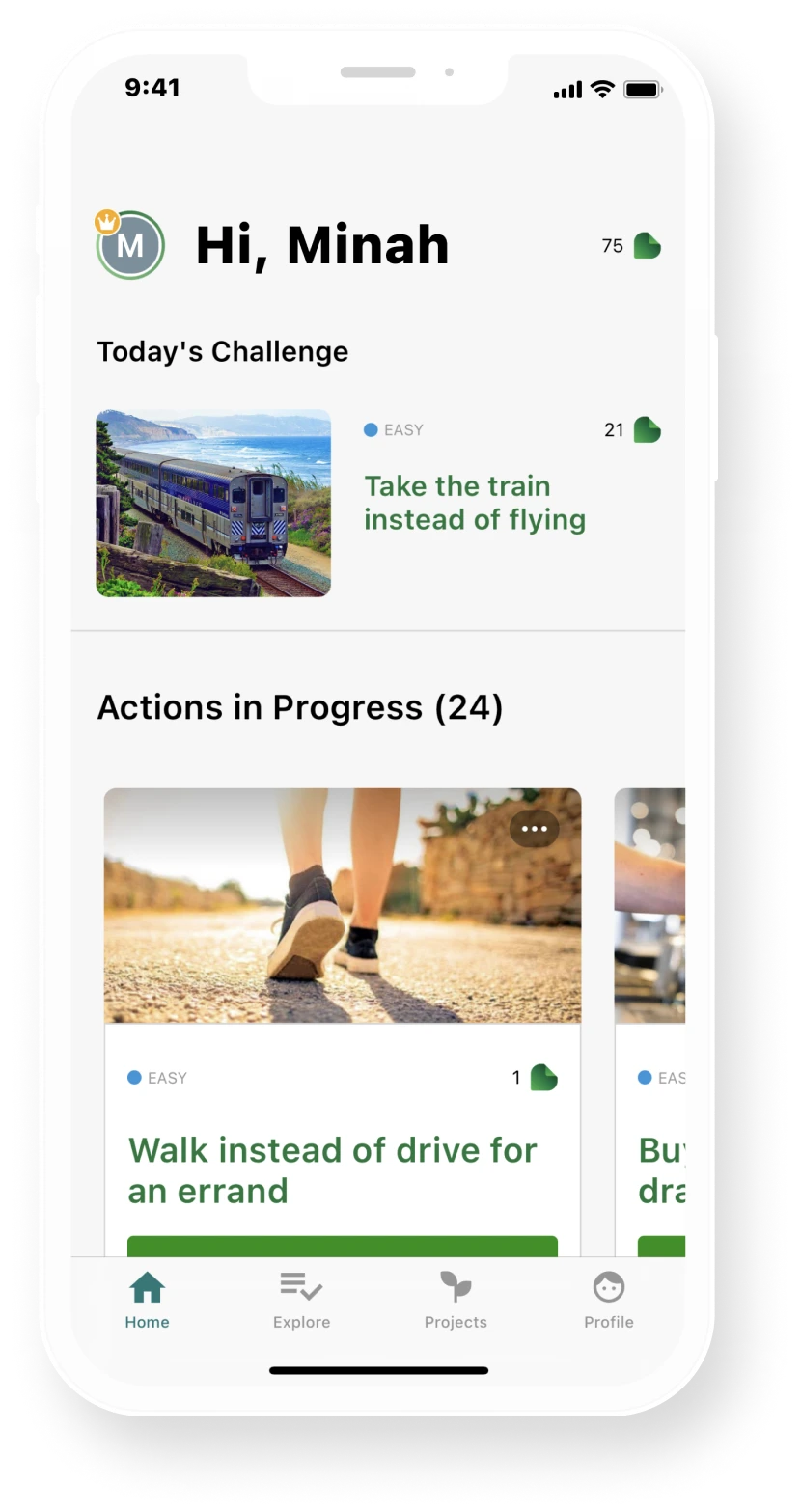
No affordances for repeatable actions.
Actions that are meant to be repeated, such as walking to the gym, aren’t easily distinguishable as repeatable because the design of the action card appears identical to other cards. They also wanted things like a redo button.
Larger tasks are difficult to complete.
Users expressed a desire to break down larger tasks into smaller sub-tasks for improved ease of completion.
No customization of notifications.
Users have little interest in notifications and want more freedom to customize when they receive notifications.
No affordances for repeatable actions.
Actions that are meant to be repeated, such as walking to the gym, aren’t easily distinguishable as repeatable because the design of the action card appears identical to other cards. They also wanted things like a redo button.
Larger tasks are difficult to complete.
Users expressed a desire to break down larger tasks into smaller sub-tasks for improved ease of completion.
No customization of notifications.
Users have little interest in notifications and want more freedom to customize when they receive notifications.
RESEARCH
How do users form habits?
How do users form habits?
After understanding the challenges users faced when it came to their experience with the app, we wanted to explore different ways to motivate them to stay consistent with their sustainable habits.
After understanding the challenges users faced when it came to their experience with the app, we wanted to explore different ways to motivate them to stay consistent with their sustainable habits.
INSIGHTS
68%
68%
of our users say breaking apart large tasks into smaller sub-tasks helps them stay consistent with their goals.
of our users say breaking apart large tasks into smaller sub-tasks helps them stay consistent with their goals.
54%
54%
of our users mentioned finding a way to track their progress helped them complete a goal.
of our users mentioned finding a way to track their progress helped them complete a goal.
DESIGN REDIRECTION
There was a problem. Our research showed that notifications were doing little to nothing with changing people’s behavior. We knew we had to shift gears. We found many usability issues in the app's core experience and missed opportunities to leverage external motivation to increase engagement. So our redesign focused on incorporating motivational design elements and improving the usability issues found in our research.
There was a problem. Our research showed that notifications were doing little to nothing with changing people’s behavior. We knew we had to shift gears. We found that there were a lot of usability issues with the core experience of the app and missed potential for leveraging external motivation to increase engagement. So our redesign focused on incorporating motivational design elements and improving the usability issues found in our research.
UPDATED DESIGN QUESTION
How might we engage users in building sustainable habits, ensuring long-term engagement through improving the discovery ofactions, optimizing the design of action cards,andintegrating motivational design elements?
How might we engage users in building sustainable habits by improving action discovery, optimizing action-card design, and integrating motivational design elements to ensure long-term engagement?
DESIGN
Key design features
Key design features

Thorough onboarding process
Develop an onboarding process that lets users pick a sustainability goal and related actions. The goal is to make the experience more personalized by letting users focus on actions that matter to them and align with their interests and objectives.

To-do list layout
Re-design the homepage layout to a to-do list layout for a more organized and efficient user experience. This design eliminates endless scrolling, making it easy for users to find completed actions and receive tailored daily action suggestions that they can customize.

Incorporate motivational design
Introduce a progress bar and streaks so that users feel incentivized to complete actions and stay engaged with the app.

Customizable notifications
Introduce a notification settings page where users have increased control of when and what type of notifications they receive, avoiding unnecessary and unwanted notifications.
Thorough onboarding process
Develop an onboarding process that lets users pick a sustainability goal and related actions. The goal is to make the experience more personalized by letting users focus on actions that matter to them and align with their interests and objectives.
To-do list layout
Re-design the homepage layout to a to-do list layout for a more organized and efficient user experience. This design eliminates endless scrolling, making it easy for users to find completed actions and receive tailored daily action suggestions that they can customize.
Incorporate motivational design
Introduce a progress bar and streaks so that users feel incentivized to complete actions and stay engaged with the app.
Customizable notifications
Introduce a notification settings page where users have increased control of when and what type of notifications they receive, avoiding unnecessary and unwanted notifications.
WIREFLOWS
Detailing architecture through wireflows
Detailing architecture through wireflows
We completely transformed how the user navigates through the app. The whole experience revolves around users completing goals rather than random individual actions. To visualize how the different screens interact with one another, our team created wireflows.
We completely transformed how the user navigates through the app. The whole experience revolves around users completing goals rather than random individual actions. To visualize how the different screens interact with one another, our team created wireflows.

ZOOMING IN ON WIREFLOWS
Re-imagining how users discover actions
Re-imagining how users discover actions
Rather than overwhelming users with a vast array of actions, we've introduced a personalized action plan. This plan features 1-3 tailored daily suggestions and upcoming tasks that users can easily rearrange based on their convenience. Informed by the user's goals shared during onboarding, this approach streamlines the experience, eliminating the need for users to sift through countless actions. The to-do list layout adds a mental checklist, potentially boosting user motivation to complete tasks. We also added a progress bar and streaks to motivate people to complete actions.
Rather than overwhelming users with a vast array of actions, we've introduced a personalized action plan. This plan features 1-3 tailored daily suggestions and upcoming tasks that users can easily rearrange based on their convenience. Informed by the user's goals shared during onboarding, this approach streamlines the experience, eliminating the need for users to sift through countless actions. The to-do list layout adds a mental checklist, potentially boosting user motivation to complete tasks. We also added a progress bar and streaks to motivate people to complete actions.

ZOOMING IN ON WIREFLOWS
Providing more affordances to repeatable actions
Providing more affordances to repeatable actions
In our research, users mentioned they wanted more affordances to repeatable actions. In our re-design, after a user checks off a repeatable action they receive a pop-up asking them if they want to schedule this action to appear in their plan again and when they want to receive it.
In our research, users mentioned they wanted more affordances to repeatable actions. In our re-design, after a user checks off a repeatable action they receive a pop-up asking them if they want to schedule this action to appear in their plan again and when they want to receive it.

ZOOMING IN ON WIREFLOWS
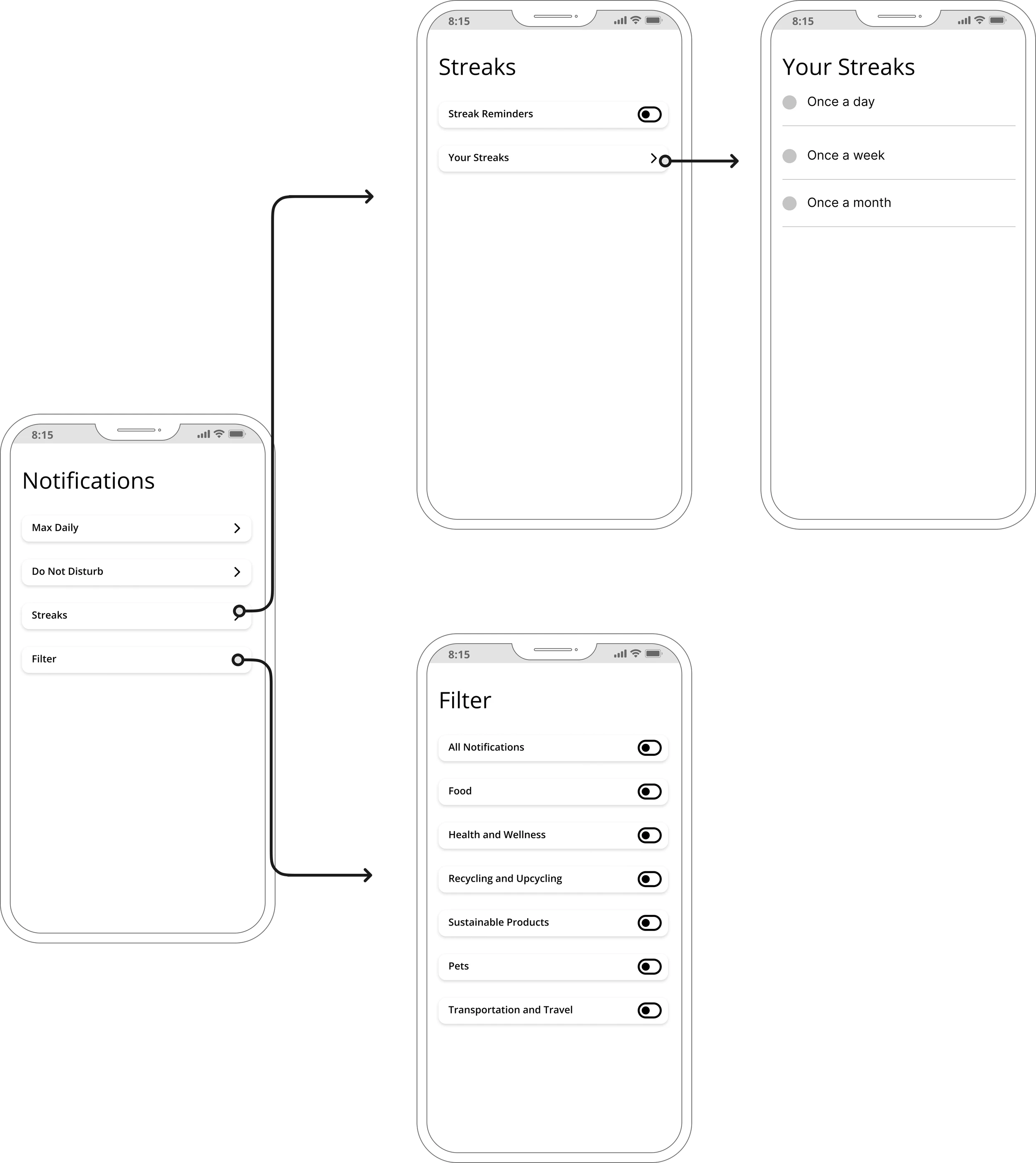
Customizing notifications
Customizing notifications
Users can customize the type of notifications they want to see and how often they want to be reminded of their streaks. Thus, preventing notification fatigue and loss of interest in the app.
Users can customize the type of notifications they want to see and how often they want to be reminded of their streaks. Thus, preventing notification fatigue and loss of interest in the app.
USABILITY TESTING
Validating and refining the wireframes
Validating and refining the wireframes
It was important to hear what our users had to say in order to catch usability issues and eliminate preconceived assumptions that had emerged from the research and ideation phases. To evaluate the revised app's usability, users were asked to rate it using the US government System Usability Scale (SUS), while also providing feedback on their overall application experience.
It was important to hear what our users had to say in order to catch usability issues and eliminate preconceived assumptions that had emerged from the research and ideation phases. To evaluate the revised app's usability, users were asked to rate it using the US government System Usability Scale (SUS), while also providing feedback on their overall application experience.
4 users
4 users
recruited from our friends and acquaintances
recruited from our friends and acquaintances
4 tasks
4 tasks
completed by our users
completed by our users
FINDINGS
Key insights
Key insights
Users desired more information before selecting a goal.
Frustrations over goal card not being clickable.
Users were unable to locate the complete button.
Users were confused by the terminology in the notification settings.
Users desired more information before selecting a goal.
Frustrations over goal card not being clickable.
Users were unable to locate the complete button.
Users were confused by the terminology in the notification settings.
FINAL DESIGNS
Medium - fidelity prototypes
Medium - fidelity prototypes
We implemented the findings from our usability test and leveraged the existing Get Green Style Guide to create the interactive medium-fidelity prototypes.
Repeatable Action Design
We enhanced the intuitiveness of repeating actions by employing user-friendly language and transitioning from selecting specific dates to choosing frequency.
Card Layout
We transitioned from a to-do list format to a card layout, providing users with more upfront information about the action, eliminating the need for additional clicks to learn more.
Goal and Action Information
We included more information about each goal and action in the onboarding process.
Cleaner Interaction Design
We made the entire goal card and action clickable.
We implemented the findings from our usability test and leveraged the existing Get Green Style Guide to create the interactive medium-fidelity prototypes.
Repeatable Action Design We enhanced the intuitiveness of repeating actions by employing user-friendly language and transitioning from selecting specific dates to choosing frequency.
Card Layout We transitioned from a to-do list format to a card layout, providing users with more upfront information about the action, eliminating the need for additional clicks to learn more.
Goal and Action Information We included more information about each goal and action in the onboarding process.
Cleaner Interaction Design We made the entire goal card and action clickable.
CONCLUSION
Reflection
Reflection
Be adaptable
Projects rarely follow a straight path, and flexibility is crucial to meeting changing requirements. It’s important to not get stuck on one idea or solution and allow your project to evolve based on the new information.
Users first, solutions second
The project began with a solution, which later revealed to be ineffective based on user research. This underscores the importance of not going into the process with a solution in mind but rather with the intention to understand your users and explore the problem space with an open mind. It’s not about assuming what your users need and using research to validate that, rather its about understanding your users and designing for how they behave.
More research doesn’t mean better
Quality over quantity is just as relevant in the context of user research. Even though the diary study brought to light a crucial discovery—specifically, that geo-location notifications had limited influence on behavior—the depth of insight gained did not match the resources invested in it. Most of our valuable insights actually stemmed from the participatory design session and survey. Therefore, it’s important to be thoughtful about what research methodology to use in order to save time and money.
Be adaptable Projects rarely follow a straight path, and flexibility is crucial to meeting changing requirements. It’s important to not get stuck on one idea or solution and allow your project to evolve based on the new information.
Users first, solutions second The project began with a solution, which later revealed to be ineffective based on user research. This underscores the importance of not going into the process with a solution in mind but rather with the intention to understand your users and explore the problem space with an open mind. It’s not about assuming what your users need and using research to validate that, rather its about understanding your users and designing for how they behave.
More research doesn’t mean better Quality over quantity is just as relevant in the context of user research. Even though the diary study brought to light a crucial discovery—specifically, that geo-location notifications had limited influence on behavior—the depth of insight gained did not match the resources invested in it. Most of our valuable insights actually stemmed from the participatory design session and survey. Therefore, it’s important to be thoughtful about what research methodology to use in order to save time and money.